
Let’s talk money. Travelling to Disneyland Paris with the family has never been exactly cheap, but from 2026 onward, if you don’t understand how the resort’s economy works, it can become a genuine financial bloodbath.
Some families still think like the old days, waiting for a last-minute deal. They hold off buying tickets until everything’s confirmed and suddenly find themselves paying €110 per person to enter a packed park.
In the era of Yield Management (Disney’s dynamic pricing, which works exactly like the airlines), improvisation is punished with money.
But Disney’s algorithm has a weakness. A back door for those who know how to read the data. We call it the “Grade A” crowd level. Knowing it and getting ahead of it will easily save you €300 on your next trip, and as a bonus, it’ll give you the shortest queues of the entire year. Here’s how to play (and win) the pricing game.
🤖 The “Uncomfortable Truth”: How the System Squeezes You
First, you need to understand your enemy. At Disneyland Paris, there is no longer a fixed entry price.
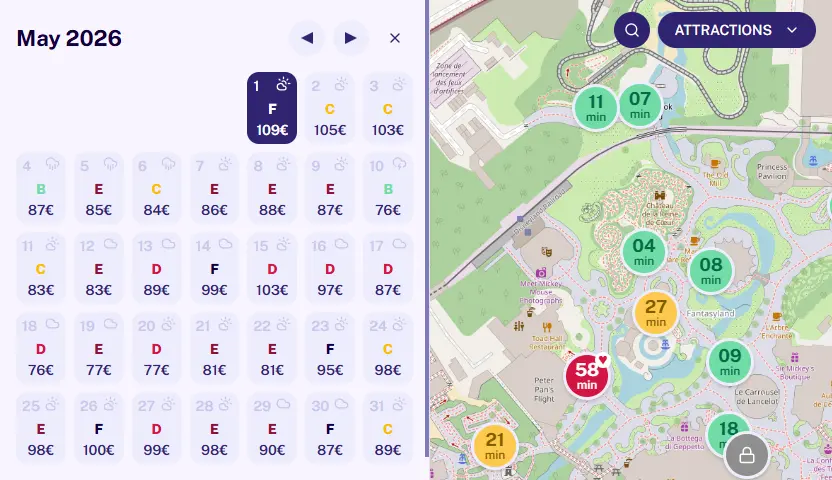
A rainy Tuesday in January might cost €56. A sunny Saturday in May, that exact same ticket costs €105. That’s nearly double for exactly the same park.
But the trap doesn’t end with the calendar. The algorithm tracks demand in real time. If Disney detects that a “cheap” November weekend is starting to fill up with hotel bookings, the system automatically raises standalone ticket prices on a daily basis. If you wait until the week before your trip to buy passes, the algorithm knows you’re desperate. And it’ll charge you the maximum rate.
🟢 What Is “Grade A” and Why Is It Worth Its Weight in Gold?
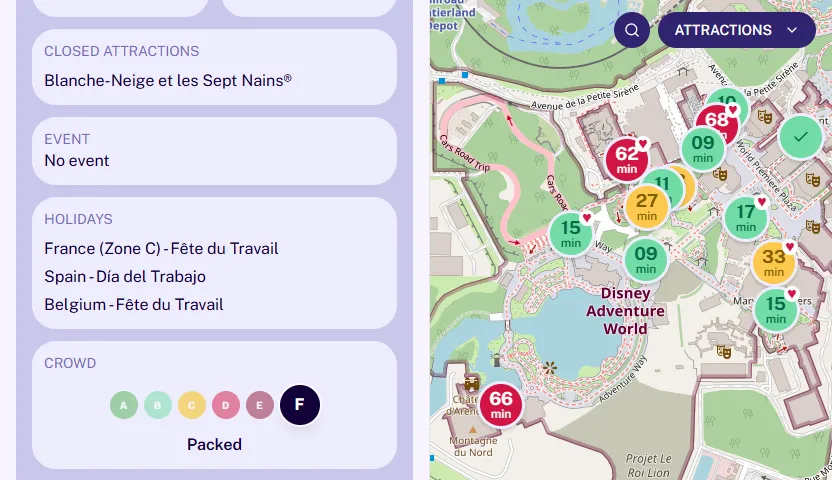
At MagicWait Paris we grade every day of the year. It goes from Grade A (ghost town, minimum crowd level) to Grade F (zombie apocalypse, packed to the rafters).
Grade A is the Holy Grail of theme parks. It tends to land on very specific dates: midweek in January, early February, the second half of September, and scattered days in November.
Where’s the saving? Let’s Do the Basic Maths:
- Family of 4 on a “Grade E” day (Weekend / Holidays): 4 tickets x €105 = €420
- Family of 4 on a “Grade A” day (Low-season Tuesday): 4 tickets x €56 = €224
Shifting your trip by just 48 hours (from a Saturday to a Tuesday) doesn’t just save you from the crowds, it puts nearly €200 straight back in your pocket for each park day. If you’re going for two days, you’ve just saved €400. That’s the entire food and souvenir budget for your whole trip.
⏳ The 90-Day Tactic: Lock in the Price Before It Rises
Knowing that Tuesdays in November are cheap is the easy part. Here comes the expert-level move almost nobody uses: The 90-Day Advance Purchase.
To fill the “Grade A” days, Disney releases a very limited batch of super-reduced base tickets (the famous Eco Tickets). The problem is that as soon as that small batch sells out, the algorithm starts raising prices in stages, even if the park is going to be empty!
If you buy your Grade A ticket one week ahead, it won’t cost €56 anymore, it’ll cost €75. You’ve lost money by not getting ahead of it.
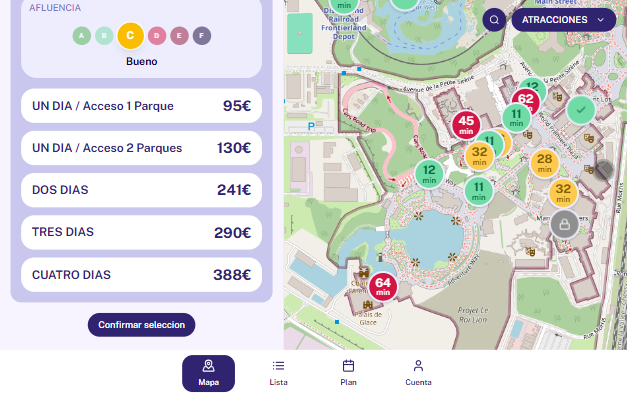
The Golden Rule: to secure Disney’s absolute floor price, you have to lock in your purchase between 60 and 90 days before your arrival date.
🎯 Don’t play Russian roulette with your savings. Download Magic Wait Paris, check our 90-day predictive calendar, and locate the Grade A days. Lock in your date, buy at the lowest price of the year, and spend that €300 you saved on a spectacular character dinner. Try it free.
🔮 How to See the Future and Get Ahead of the Crowd
The logical question is: “How do I know exactly which days will be Grade A three months from now?”
You don’t guess. You calculate with data intelligence. School holidays in France, Belgium, and Spain change every year and are a minefield. A Tuesday in February might look like low season to you, but if it coincides with the Paris Zone C winter holidays, the park will be packed and you’ll have paid top dollar.
This is where your tactical advantage comes in: MagicWait Paris. Our system analyses years of historical data, European holidays, and demand patterns to give you a Crowd Prediction months in advance.
We tell you exactly which days in the next 90 days are Grade A, B, C, D, or E. All you have to do is open the calendar, find the bright green band (Grade A), and buy your tickets on the official Disney website before the algorithm starts inflating prices.
🚀 The Double Victory: Half the Price, Zero Stress
Landing a Grade A day isn’t just a financial win; it’s a life win.
Paying €110 in peak season means spending your day queuing 80 minutes to ride three measly attractions. It’s the most expensive and most frustrating trip possible.
Paying €56 on a Grade A day means riding Big Thunder Mountain with a 15-minute wait. It means being able to re-ride Spider-Man W.E.B. Adventure, grabbing a table for lunch without stress, and strolling through the new World of Frozen without being shoved.
You’ve just paid half, to enjoy twice as much.
📋 Your 3-Step Financial Action Plan
So you don’t let a single cent slip away, save this list:
- Set your sights 3 months out: if you want to travel cheap, forget about next month. Start planning today for a trip 60-90 days from now.
- Consult the Oracle: open the MagicWait Paris calendar. Filter by the weeks you’re interested in and look for the days marked with the lowest crowd level (Grade A/Green). Run from the red spots.
- Buy without hesitation: go to the official Disney website and lock in your tickets for those specific days. (Remember, if a family emergency comes up, standard dated tickets can be cancelled up to 3 days before your visit for a full refund.)
The magic of Disneyland Paris has a price. But if you play the data in your favour, you’ll be the one deciding how much to pay for it.