If there is one attraction at Disneyland Paris that defines the word “nostalgia,” it is this one.
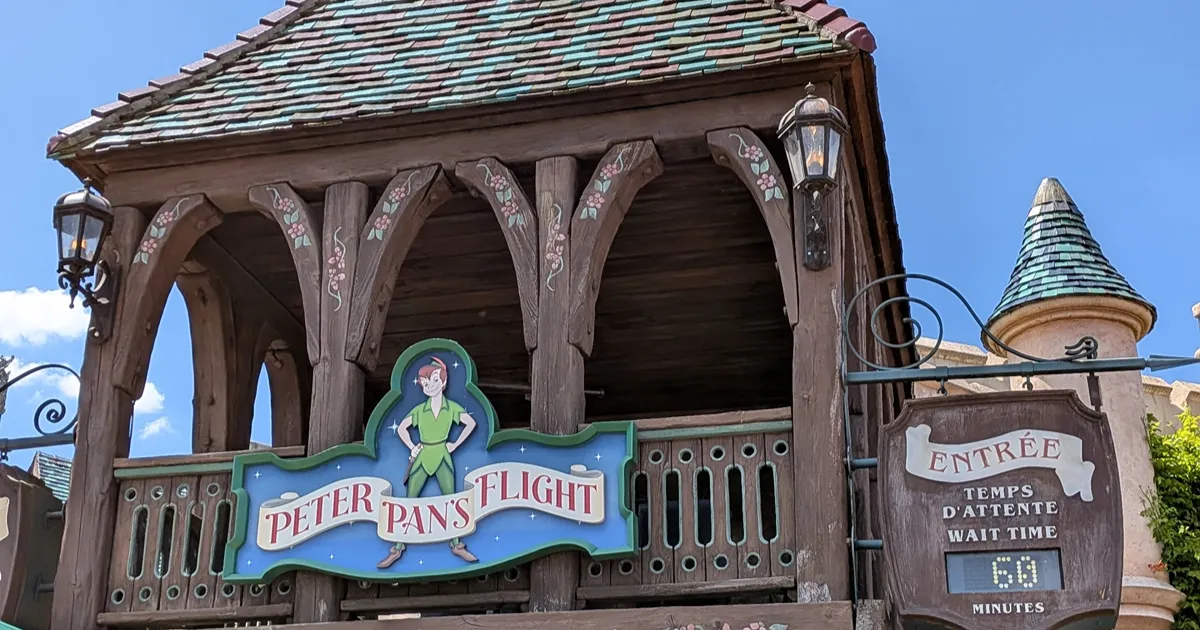
Peter Pan’s Flight is a rite of passage. No matter how old you are, flying over London’s rooftops at night in a pirate galleon still tugs at anyone’s heart. It has something that newer, more technologically advanced attractions cannot buy: the weight of seventy years of history and the ability to make a grown adult feel seven years old again.
It also has Fantasyland’s most infamous queue. But you already know that.
What you probably do not know is that this attraction you have memorized hides layers of theatrical engineering invented in the 1950s, a concept error that took decades to correct, and a secret renovation that changed everything without anyone noticing. Here are the 10 secrets of Neverland.
🚀 1. It was the only attraction on opening day, and it is still the same
Peter Pan’s Flight is one of the few attractions that was operational on Disneyland California’s opening day, July 17, 1955. Seventy-one years later, it still exists in five Disney parks around the world.
At Disneyland Paris, it opened on April 12, 1992, the same day the park welcomed its first guests. That means it has been flying over London every single day for more than three decades, without exception. Along with Pirates of the Caribbean and Phantom Manor, it is one of the three attractions that form the resort’s historical core from its very first minute of life.
To put that in perspective: when Peter Pan’s Flight opened in Paris, Frozen Ever After did not even exist as a movie.
🤔 2. The original idea was that you were Peter Pan, and the public did not get it
This is the most interesting design misunderstanding in the attraction’s history.
The original intent was for visitors to fly through the ride as if they were Peter Pan himself. The problem was that the public did not understand this concept and kept wondering why Peter Pan never appeared in his own attraction.
Walt Disney wanted a first-person experience: you are Peter Pan, you fly, you see the world from above. But visitors, used to seeing Disney characters inside the rides, expected to find Peter Pan somewhere in the scenes. When they did not see him, they felt something was missing.
The solution was to add Peter Pan as a visible character throughout the ride, breaking the original design logic. Since then, the protagonist appears in several scenes even though that technically means you are flying with Peter Pan instead of being Peter Pan. A compromise between the creator’s vision and what the audience expected to find.
🚂 3. The London traffic is a bicycle chain
This is the most surprising curiosity in the entire attraction for anyone who discovers it for the first time.
In the most iconic scene of the ride, your galleon flies out of the Darlings’ window and you soar over a miniature London at night. You see tiny cars moving through the streets with their headlights on, the Thames, Big Ben, the Victorian rooftops.
Those cars are not miniature electric vehicles. They are not screens. They are simple dots of phosphorescent paint applied to a motorized bicycle chain that runs in a loop beneath the set. Your brain, tricked by perspective and darkness, does the rest and interprets that movement as traffic.
It is analog engineering from the 1950s that still fools millions of people in 2026. And it will keep fooling them fifty years from now.
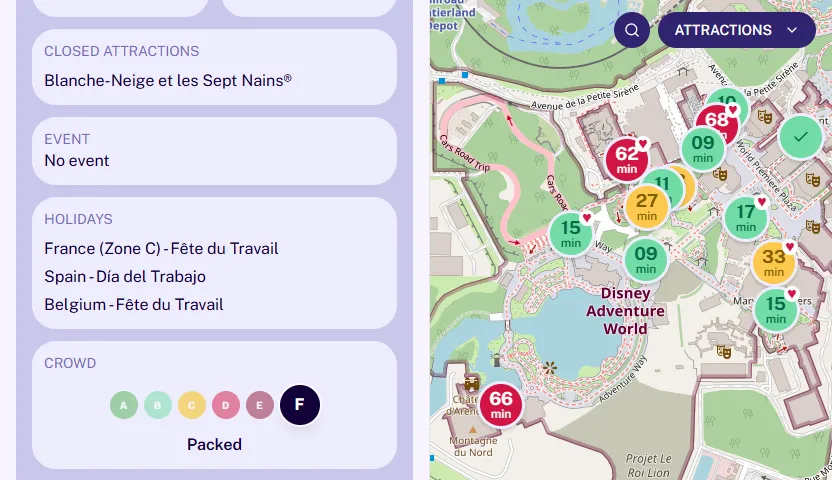
🎢 The magic is in the details you cannot see at first glance. With MagicWait Paris you see wait times in real time and plan your visit so you never waste a minute in line. Start free and fly without waiting.
🎨 4. All of Neverland is hand-painted with ultraviolet light
There are no LED screens. No state-of-the-art projections. No modern technological trick behind Neverland’s impossible colors.
The entire set is hand-painted with special blacklight-sensitive paint. Inside the attraction there is almost no normal light: hundreds of hidden UV fixtures make the fluorescent paint “burn” in the darkness, creating that fairy-tale look that cannot be replicated on video.
The major 2016 renovation modernized the lighting, animatronics, shadows, and projections without altering the layout. Jim Crouch from Walt Disney Imagineering California supervised six weeks of collaboration between French teams and ultraviolet painting specialists from Walt Disney World.
That paint job, which took weeks to complete and was supervised by specialists brought in from Florida, is what makes the attraction look exactly as magical as day one, despite having been in operation for more than three decades.
🔤 5. The nursery’s wooden blocks spell out something
Before taking off, your galleon passes through the nursery of Wendy, John, and Michael. It is a quick scene and you are looking at Nana and the sleeping children.
On the floor of the room there are wooden letter blocks, the classic children’s toys. If you read them in the second you have before flying out the window, they are not random: the blocks spell out “D1SN3Y” when read in sequence. A discreet signature placed at the exact point where the attraction takes flight.
Also, look at the corner of the nursery: there are two dolls that are not random. At the start of the nursery, a tea party with two famous toys, Raggedy Ann and Andy, can be seen in a corner. They are characters from a completely different story than Peter Pan, placed there as a nod to another era of American animation.
🪂 6. Do not look up, or you will see how the magic works
Peter Pan’s Flight was a revolution when Walt Disney designed it because it was the first attraction in history where the vehicles do not run on the ground.
To create the sensation of flight, the galleons are suspended from a rail fixed to the ceiling. The upper rail from which the galleons hang is invisible from the vehicles. You only see the sets below and the sky. Because the cabin forces you to look forward and down, your brain loses its reference to the floor and the flying effect is complete.
If you want to keep the magic intact, do not look directly at the black ceiling. That is where the massive industrial steel rails that hold your boat live. Once you see them, it is hard to unsee them on every ride. What looked like magic turns out to be engineering. Both things are true at the same time.
🌍 7. The Paris version is the longest, and has more seats than the American ones
If you have spoken with visitors who know other versions of the attraction around the world, they will have told you that the California or Florida galleons have two seats. In Paris they are larger.
The Disneyland Paris version stands out with three features that no other historical version shares simultaneously: a duration of ~3 minutes (versus ~2 min 30 in Anaheim and Magic Kingdom), 4-seat galleons (versus 2 in the original versions), and a fully themed queue renovated in 2014 that takes visitors through the Darling nursery before boarding.
Three minutes may seem short. But it is 20% more time than in California. And the four-seat galleons are the reason the Paris version, despite its low overall capacity, can move slightly more people per hour than its American sister versions.
🌕 8. Neverland’s full moon hides Mickey
The designers’ signature could not be missing.
When your galleon flies over Neverland island, it passes near a full moon projected on the back wall. Pay attention to the craters and shadows on that moon. They are not random: they form the classic silhouette of Mickey Mouse’s head, the three unmistakable circles.
It is Peter Pan’s Flight’s Hidden Mickey, and it is so well integrated that most visitors look at it on every ride without seeing it. The moon is large enough that, if you know what you are looking for, you see it clearly. The problem is that the scene passes in a matter of seconds and the brain does not have time to process the detail unless you are actively looking for it.
🗺️ 9. The mini-London is not built to scale, and it is deliberate
The model of London you fly over is not a faithful reproduction of the city at reduced scale. It is a deliberate visual trap.
The Imagineers applied forced perspective: the buildings in the background are smaller than those in the foreground, amplifying the illusion of depth and altitude. This technique, used since the 1955 Anaheim version, reaches an unusual level of detail in Paris: Big Ben, the Thames, the Victorian rooftops, all pass by in a few seconds of flight.
At 5 meters above the London model, you understand why the wait exceeds an hour. Forced perspective makes the model appear to extend much farther than it actually does, and that illusion of depth is what creates the feeling of really flying over a real city, not a set piece.
It is the same technique Disney used to make Disneyland Paris’s castle appear taller than it is: the upper blocks are progressively smaller than the lower ones, tricking the eye into calculating a greater height than the actual one.
🧮 10. The math of the queue and why it will never improve without a redesign
This is the most practical curiosity and the one with the most impact on your visit day.
The attraction has 16 flying boats that seat 5 people each, inaugurated in April 1992. With a cycle of about 3 minutes per boat plus boarding and unloading time, the real capacity is around 800-1,000 people per hour. For comparison: Pirates of the Caribbean moves ~3,400 people per hour.
If there are 800 people in the Peter Pan queue, the mathematical wait is approximately one hour. If those same 800 people went to Phantom Manor, they would be inside in 15 minutes. Same number of people. Completely different math.
The structural solution would involve redesigning the attraction, something Disney has deliberately ruled out to preserve its original character. The 2016 renovation modernized everything that could be modernized without altering the layout. But the capacity remains the same as in 1992. And demand has grown.
The result is a queue that is, technically, unsolvable without a major intervention.
💡 Tips for flying to Neverland without losing your patience
⏱️ The three windows that work
🌅 Extra Magic Time (Disney hotel guests): in the first 30 minutes of exclusive opening for hotel guests, Peter Pan has practically no queue. It is the only window of the day where you can walk on without a significant wait. If you are staying at a Disney hotel, this attraction must be your absolute first stop.
🎪 During the parade (Disney Stars on Parade): when the parade music starts playing, 80% of Fantasyland families migrate toward the float route. It is the only afternoon moment when the Peter Pan queue predictably and consistently drops to half. If you do not mind missing the floats, that is your window.
🌙 Last hour before park close: families with young children, the attraction’s main audience, leave the park before closing. The queue drops noticeably in the final stretch of the day, especially in the last 45 minutes before closing.
📱 Peter Pan’s line is visually deceptive because it is squeezed into narrow hallways. Do not trust your eyes. With MagicWait Paris you see the real wait time before heading to Fantasyland and know exactly whether you are in one of the three windows or whether it is better to wait. Access it for free!
📋 Practical information
- Minimum height: no restriction
- Type: suspended dark ride (overhead track), with 16 scenes
- Duration: ~3 minutes, the longest version in the world
- Capacity: 16 galleons of 4-5 seats
- Single Rider: not available
- Premier Access: available, one of the best uses for it in the park
🔍 What not to miss
- The wooden blocks on the nursery floor, look for “D1SN3Y” before flying out the window
- The Raggedy Ann and Andy dolls at the tea party in the nursery corner
- The Hidden Mickey on the moon of Neverland, look for the three circles in the craters
- The London traffic trick, now that you know it is a bicycle chain, try to spot the mechanism
- The forced perspective of the model, notice how the background buildings are progressively smaller
🌟 Conclusion
Peter Pan’s Flight has been running for seventy years and remains one of the most in-demand attractions in any Disney park in the world. Not because it is the most technologically advanced, it clearly is not. But because it does something that even the most advanced technology cannot guarantee: it makes you feel something real.
Next time you fly over London, do not just look forward. Look at the floor and find the bicycle chain. Look at the moon and find Mickey. Read the blocks before flying out the window.
Magic and engineering are the same thing. Magic is just what you feel when you cannot see the mechanisms.
Want to know when Peter Pan has the shortest queue on your visit day? Check real-time wait times at MagicWait Paris and plan the exact moment to fly to Neverland without waiting.